
The Dead Label Problem: Where Send-It-In Businesses Lose Revenue They Already Won

Prospect asks for a prepaid shipping label. Your team sends it. The CRM says won.
Article Summary
- Many mail-in leads are won in conversation, then lost between prepaid label and first carrier scan.
- After the label issues, the customer owns the next step. If you do not instrument that stage, the drawer wins.
- Treat tracking numbers as live sensors: day-3 / day-7 / day-14 nudges recover silent inventory.
- Speed still matters before the label. Automate intake so a 40-minute ritual becomes a two-minute confirm.
Why send-it-in funnels break where lead-gen funnels do not
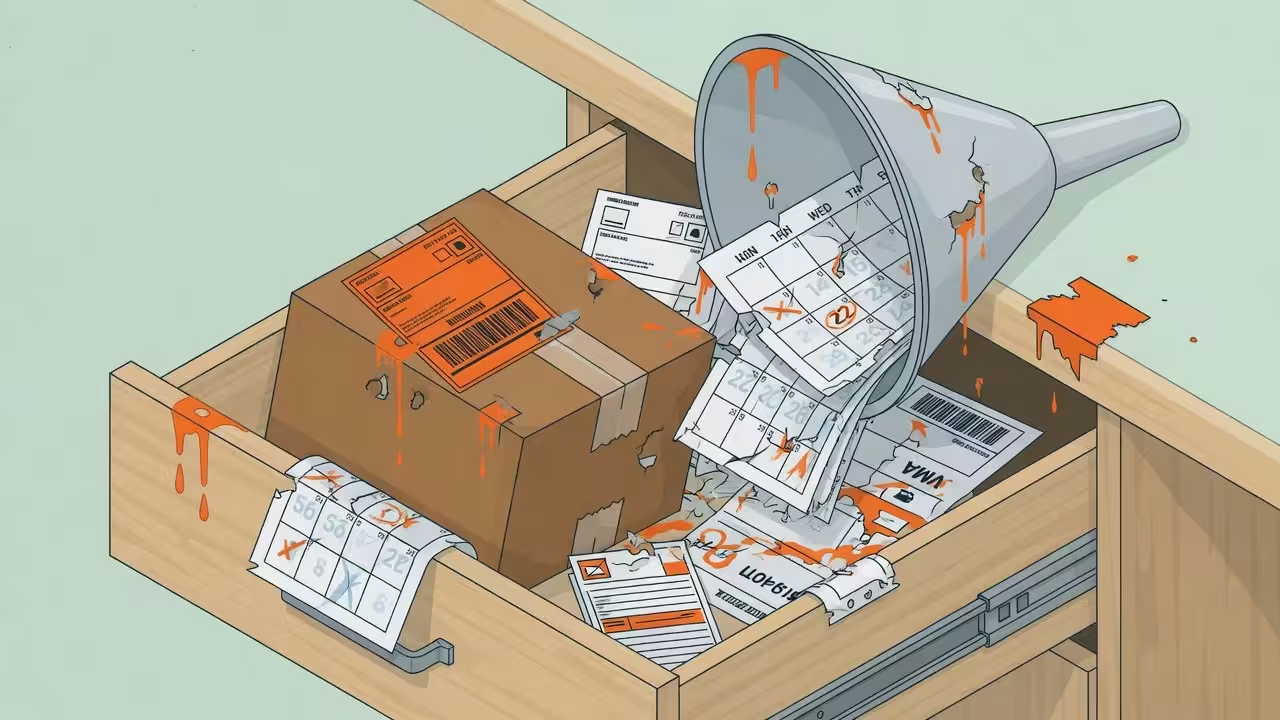
Classic lead gen fails when you are slow to answer. Mail-in adds a second boss: physics. After the label is issued, your CRM often marks success too early. Marketing stops messaging because "they converted." Ops only wakes up when a scan hits. The customer's life gets busy. The drawer wins.
This is cousin to the speed-to-lead lesson in our storm damage article for contractors, but the leak is not only the missed call. The leak is the unshipped box. It shows up for device repair depots, electronics refurb, jewelry and watch service, instrument repair, calibration labs, apparel alterations with mailers, trade-in programs, and specialty resale.
Map the stages (and who owns the next action)
Print this table. Circle every row where the customer owns the next action. Those rows need instrumentation. That is how you stop relying on hope and start running an air-tight sequence.
| Stage | Who owns next action | Typical failure | Recovery idea |
|---|---|---|---|
| StageInquiry | Who owns next actionBusiness | Typical failureSlow reply, voicemail | Recovery ideaInstant answer + qualify |
| StageQuote | Who owns next actionBusiness | Typical failureVague price, friction | Recovery ideaClear range + decision CTA |
| StageLabel issued | Who owns next actionCustomer | Typical failureDrawer death | Recovery ideaTimed nudges + easy reprint |
| StageIn transit | Who owns next actionCarrier / customer | Typical failureDamage, delay, wrong shop | Recovery ideaProactive delay SMS; address verification |
| StageReceived | Who owns next actionBusiness | Typical failureIntake backlog; internal theft risk | Recovery ideaScan + photo + chain of custody |
| StageEstimate | Who owns next actionBusiness | Typical failureSilence after intake | Recovery ideaSLA clock + portal update |
| StageApproval | Who owns next actionCustomer | Typical failureSticker shock, no context | Recovery ideaOptions A/B, photos, warranty |
| StageRepair / work | Who owns next actionBusiness | Typical failureStatus black hole | Recovery ideaMilestone pings |
| StageReturn ship | Who owns next actionBusiness | Typical failureNo tracking shared | Recovery ideaAuto send tracking |
| StageReview | Who owns next actionCustomer | Typical failureNever asked | Recovery ideaSatisfaction check, then ask |

The boring part still wins jobs: speed to first response
Before there is a label, there is a human or an AI voice on the line. Lead response research in the MIT/InsideSales tradition has long shown that contacting a lead within about five minutes massively outperforms waiting half an hour on contact and qualification odds. Broader audits of firm response times have also found multi-day averages, which is how you fund your competitor's week.
Voicemail is not a strategy. It is a handoff. Pair lifecycle ops with answering systems that qualify and book. At Xeal that often means voice AI and automation that capture details while your bench stays on billable work.
PRO TIP Measure two clocks, not one. Clock A: inquiry to first meaningful response. Clock B: label issued to first carrier scan. Both deserve dashboards.
Instrumentation: carrier truth beats CRM fiction
The fix is not "send more hopeful emails." The fix is to treat the tracking number as a live sensor, and to treat "I shipped it" as a claim until a scan proves it.
- Store carrier + tracking at label creation
- Subscribe to scan webhooks or poll status
- Define states: created, still unscanned, in transit, delivered to you, exception
- Fire different messages by age of unscanned label
- Pause marketing "win" celebrations until first scan or explicit cancel
- Log chain of custody at intake so internal loss is not invisible
| Day since label | Message job | Goal |
|---|---|---|
| Day since label1 | Message jobConfirm label + reprint link + packing tips | GoalReduce friction |
| Day since label3 | Message jobSoft reminder + need a different size box? | GoalWake the drawer |
| Day since label7 | Message jobDirect ask + offer schedule pickup if available | GoalRecover intent |
| Day since label14 | Message jobFinal notice + label expiry policy | GoalClean pipeline |
| Day since label21 | Message jobClose loop in CRM as expired / recycle later | GoalHonest forecasting |
PRO TIP Every nudge should include one tap: reprint label, schedule pickup, or cancel my repair. Ambiguity keeps drawers full.
Prepaid labels, fraud, and break-even math
Owners worry about postage abuse. Valid. Also valid: people who never intended to ship, people who ship the wrong item, and people who open a free diagnostic path they will never finish. Business reply and untracked flows create disputes and ghost inventory you cannot see. Work the break-even like an adult: average job gross profit, label postage and packaging, percent of labels that never scan, percent of fraud/abuse, and cost of a staffed "where is my kit?" call. Often a tracked label with aggressive recovery messaging beats a cheap untracked process that hides the dead pile.
Customer-facing status page
If customers must call to learn "did you get it?" you built a call center by accident. Ship simple status states: evaluation received, estimate ready, approved, in repair, quality check, shipped back. That cuts inbound noise and creates a natural moment for the review ask when status hits complete. See also why review recency matters now.
40 minutes to 2 minutes: intake automation order
- Identity match - order ID, photo ID rules, serial capture prompts
- Photo set - guided customer photos before ship; staff photos on receipt
- Checklist - accessories received yes/no
- Status event - auto SMS/email "we have it"
- Estimate template - technician picks codes; customer gets plain English
- Approval - one-tap approve with payment hold policy stated clearly
Humans should still do judgment. Machines should do typing, chasing, and stamping time.
Implementation checklist
- Define lifecycle stages in the CRM (not just lead/won/lost)
- Add label_issued_at and first_scan_at fields
- Connect carrier tracking
- Build day-3/7/14 sequences
- Launch status page for in-house work
- Script first-response under five minutes (human or voice AI)
- Weekly report: labels issued vs scanned vs expired
- Quarterly fraud, postage, and chain-of-custody review
Putting it together
The prepaid label is not a closed job. It is the start of a fragile stretch where packages stall in drawers and revenue you already won disappears.
I have watched this leak for decades in mail-in repair. Instrument the stages. Nudge the dwell. Give the customer a status page. Treat speed-to-lead like it still matters after the sale starts. That is how you keep the job you thought you won.
Talk with Xeal about dead-label recovery
Share where packages stall after the label prints. We will map stages, nudges, and status so fewer jobs die in the drawer.
FAQ
How many nudges before it is annoying?
Three to four well-spaced, useful messages beat daily nagging. Always offer an exit: reprint, reschedule, or cancel.
Prepaid vs on-demand labels?
Prepaid reduces customer friction and increases ship-through if you recover dead labels. On-demand reduces postage risk. Many brands prepaid for qualified tickets only.
Does this need a new CRM?
Not always. It needs fields, stages, and automations. Switch CRMs only if your current one cannot store tracking truth and fire timed sequences.
What about UPS, FedEx, or USPS?
Use official tracking APIs or a multi-carrier layer. The brand of truck matters less than the webhook that tells you a label is still unscanned.
Does this work internationally?
Yes, with longer dwell timers. Add a customs checklist and set expectations in the quote so silence does not look like neglect.
Is this only for phone repair?
No. Any business that mails work in and out has a drawer problem waiting to happen: instruments, jewelry, apparel, trade-ins, calibration, specialty resale. The electronics shops taught me the pattern; the pattern travels.
Sources
- Lead response research tradition: MIT/InsideSales lead response management findings; broader corporate response-time benchmarks
- Xeal: Storm damage lead response
- Xeal: AI automation
- Xeal: Voice AI
- Carrier developer tracking documentation (UPS, FedEx, USPS) for implementation reference
- Operator experience: multi-decade work with electronics and mail-in repair funnels (label-to-scan loss, mis-ship, fraud claims, chain of custody)
What operators say after working with Xeal
Quotes from people who hired Tony and Xeal for websites, SEO, publicity, and strategy.
Tony is unbelievably responsive, caring and strategic with any of your digital marketing needs. He is an excellent trouble shooter and will make sure projects get completed quickly and thoroughly. What a joy to work with!
I am thrilled to recommend Tony Baker for his outstanding work developing the Convergent Strategy website. Tony's strategic expertise was evident throughout the project. He was always available to address concerns and implement changes, ensuring objectives were met with precision. His design ideas were excellent, and his commitment to quality was evident in every aspect of his work. He is a true asset to any team.
Want help putting this into production?
If this article named a problem you already feel, tell me what is stuck. We will turn the playbook into systems your team can run.