
The Flat-File Comeback: Why 25-Year-Old HTML Is Now the Fastest Path to AI Visibility

I've been building websites for over 30 years, and quite frankly before they even mattered. We built every site in HTML when a single page could take hours. Database CMS tools arrived, then WordPress, and for decades we fought updates, malware, crashes, and plugin conflicts.
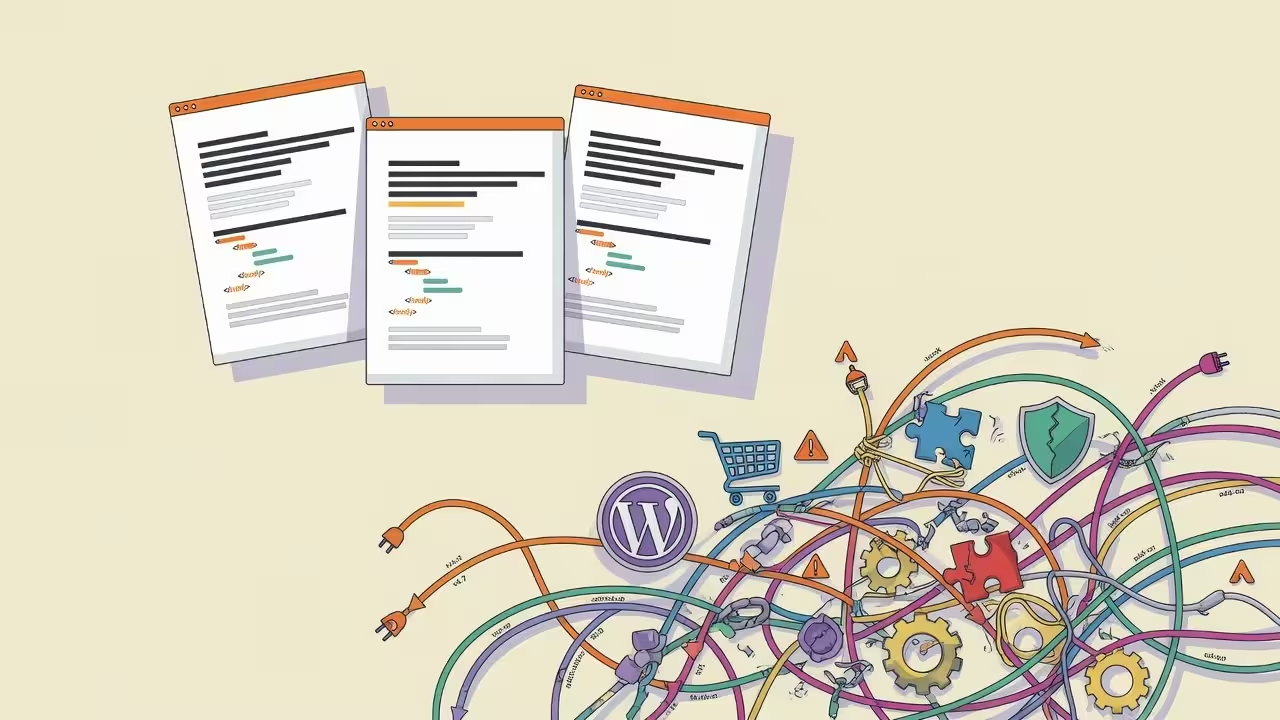
Article Summary
- A typical marketing site does not need a heavy content management system on the public domain.
- Core Web Vitals still matter: Largest Contentful Paint under 2.5 seconds, Interaction to Next Paint under 200 milliseconds, Cumulative Layout Shift under 0.1.
- Every plugin is a request, a dependency, a patch cycle, and an attack surface.
- AI inverted the old trade: hand-built HTML used to be too slow to produce. Now it is often the fastest path to a secure, high-scoring page.
- Keep apps, logins, and dashboards off the marketing domain so they never tax crawl budget or first paint.
Speed is not a style choice
When I say flat-file, I mean a marketing site shipped as HTML, CSS, and carefully chosen JavaScript, often static or near-static, without a public-facing database fighting every page load. The pages live as files. They open. They convert.
Google's Core Web Vitals still set a clear bar for a good experience:
| Metric | What it measures | Good threshold |
|---|---|---|
| MetricLargest Contentful Paint (LCP) | What it measuresLoading of main content | Good threshold2.5 seconds or less |
| MetricInteraction to Next Paint (INP) | What it measuresResponsiveness after tap or click | Good threshold200 milliseconds or less |
| MetricCumulative Layout Shift (CLS) | What it measuresVisual stability | Good threshold0.1 or less |
Those numbers are not vanity scores. They are crawl economics and buyer patience. Industry studies have long shown delays cost money: classic analyses often cite about a 7% conversion hit around a one-second delay, and Google/Deloitte's Milliseconds Make Millions work associated 0.1-second improvements with roughly 8%+ conversion lifts in retail-style experiences. Exact percentages vary by industry. The direction never does.
PRO TIP Measure mobile first. Your laptop is not the customer. Open PageSpeed Insights and GTmetrix on the homepage and the money page (quote, booking, or product). Screenshot both. That pair is your before picture.
What a CMS actually buys you
WordPress and other content management systems are not always bad. I still use the right tool for the right job. A CMS buys multi-author workflows, easy editing for large teams, and plugin ecosystems for edge cases.
What it charges you when nobody is watching:
- Plugin and theme update theater every week
- Conflict risk between plugins that never met in testing
- Render-blocking scripts you did not write and cannot name
- Database queries on pages that never needed a database
- Hosting oversized for a brochure-plus-blog that should be static
- Security patches that only exist because the attack surface exists
For a local service business, tourism operator, professional firm, or product company whose marketing site is mostly pages and proof, that trade often fails the business test. You paid for convenience in 2012. In 2026 you can have convenience and speed, because AI drafts the HTML you used to type by hand.
The plugin tax
I have opened hundreds of "simple" sites that were not simple at all. Twenty plugins. Half abandoned. Three page builders. A slider that loads more JavaScript than the rest of the brand. Caching plugins fighting each other. A security plugin papering over a stack that should not need a bodyguard.
Each plugin can mean extra HTTP requests, extra CSS and JS on every page, database options bloat, a patch schedule you will miss on a busy week, and a new way for the site to break after "one small update." That is the plugin tax. You pay it in maintenance retainers, emergency restores, and visitors who bounced before the hero image finished loading.
PRO TIP Count plugins and active scripts the way you count employees on payroll. If you cannot name what a plugin does for revenue this month, it is a candidate for removal, not a badge of sophistication.
WordPress stack vs flat HTML stack
| Dimension | Typical plugin-heavy WordPress | Flat HTML / static marketing site |
|---|---|---|
| DimensionBuild time | Typical plugin-heavy WordPressFast to start, slow to finish clean | Flat HTML / static marketing siteFast with AI and templates; disciplined from day one |
| DimensionEdit path | Typical plugin-heavy WordPressAdmin UI; depends on builders | Flat HTML / static marketing siteControlled content files, components, or approved agent edits |
| DimensionTTFB / LCP | Typical plugin-heavy WordPressOften higher (PHP + database) | Flat HTML / static marketing siteOften lower (file + CDN) |
| DimensionMonthly maintenance | Typical plugin-heavy WordPressUpdates, backups, malware scans | Flat HTML / static marketing siteDeploy, monitor, occasional content publish |
| DimensionAttack surface | Typical plugin-heavy WordPressTheme + plugins + admin + database | Flat HTML / static marketing siteMostly static files; no public admin if designed that way |
| DimensionHosting cost | Typical plugin-heavy WordPressOften oversized for the job | Flat HTML / static marketing siteCheap CDN/static hosting scales well |
| DimensionAI-crawler friendliness | Typical plugin-heavy WordPressExcellent or a mess of thin/JS-only output | Flat HTML / static marketing siteClean HTML is trivial to fetch and cite |
This is not a religious war. It is a ledger. If your marketing domain only needs to persuade, book, and prove, flat-file wins more often than the industry admits.
Why AI changed the math
Hand-coding was slow, so the industry bought abstraction: themes, builders, plugins. That trade made sense when a single landing page cost a full day of senior time.
AI inverted it. I can describe a section, generate clean markup, wire the design system, and ship a page that used to take a junior week plus a senior polish pass. The old way stopped being expensive labor and started being high leverage.
At Xeal we treat the public marketing site as an owned asset: strategy first, then a stack that does not fight Core Web Vitals. When you need apps, memberships, or heavy portals, we still build them. We just refuse to park them on the same domain that has to win the first two seconds of attention.
Architecture rule most sites get wrong
Keep the app off the marketing domain. Customer logins, portals, dashboards, and heavy application code belong on a subdomain or separate host, such as app.yourbrand.com or members.yourbrand.com.
- Marketing pages stay cacheable and thin
- A bad deploy on the app does not take down your homepage
- Crawl budget is not spent on infinite filtered admin-like URLs
- Security boundaries get clearer
- AI and search engines meet a clean, citable public site
PRO TIP If your homepage requires a logged-in cookie dance or loads the same bundle as your SaaS shell, your marketing site is subsidizing your product engineering. Split them.
Quality Score, ads, and satisfaction
Paid search still rewards relevance and experience. A slow, janky landing page trains Google Ads that your traffic is less valuable. You feel that as weaker Quality Score pressure, higher CPC, and lower conversion rate on the same keyword your competitor buys.
Organic and AI discovery punish the same sins differently: fewer engaged sessions, weaker trust signals, harder citation. A page that loads before the visitor decides to leave is easier to recommend across ChatGPT-style answer engines, Gemini, Perplexity, Copilot, and classic blue links.
10-minute speed scorecard
- Open PageSpeed Insights on homepage + top conversion URL (mobile)
- Note LCP, INP, CLS, and the largest opportunities list
- Open GTmetrix or a waterfall tool; count third-party scripts
- In WordPress (if applicable), count active plugins and screenshot
- Time a hard refresh on mid-tier mobile data if you can
- Check whether admin, cart, or app chrome loads on marketing URLs
- List every font file and hero image weight
- Ask: could this page be a static HTML file with the same copy and form endpoint?
Score each item pass/fail. Five or more fails means the stack is the project, not the brand colors.
Objection: but I need to edit it myself
You do. The question is whether "edit myself" means install twelve plugins or approve a change against a written procedure. That is the bridge to SOP-driven websites: talk, text, or email a change, see a diff, approve it, and publish, without renting a monthly report that never touches the live site.
Editing is a workflow problem. Speed is a stack problem. Solve both. Do not trade the second for a comforting admin theme.
What to do next
- Run the scorecard and save screenshots
- Separate marketing domain from app domains if they are tangled
- Kill plugins that do not map to revenue
- Rebuild the highest-value template as flat HTML/CSS with intentional JS
- Put forms and booking on endpoints that do not require a full CMS boot
- Book a free speed audit if you want a second set of eyes that has lived this loop for decades
At Xeal we build super-fast marketing sites on purpose, then wire the strategy so AI search engines and customers can actually recommend you. See also our 40-point AI visibility checklist. The golden era is not nostalgia. It is HTML that finally has the production speed it always deserved.
Proof beats a pitch. Here is a recent GTmetrix lab run on this site’s homepage: Grade A, LCP under a second, zero blocking time, zero layout shift. That is the same lightweight approach we use for client marketing pages.

Putting it together
I got tired of heavy CMS stacks taxing every edit, every ad click, and every crawl. Flat, fast marketing pages are not nostalgia. They are how you stay readable to buyers and machines without a plugin bill that never ends.
Keep the app where the app belongs. Put the brochure, service, and proof pages on a foundation you are not afraid to touch. That is the path I recommend for most marketing sites that need to convert.
Those same pages are the easiest place to add agent tools later. No new server. JavaScript on files you already own. I wrote that up in What's WebMCP and Do Entrepreneurs Really Need It?
Talk with Xeal about a faster site foundation
If WordPress feels fragile or slow on phones, tell me what the site must do. Xeal will say whether a rebuild or a surgical speed pass is the honest move.
FAQ
Is flat HTML bad for SEO?
No. Search engines and AI crawlers love clean, fast, crawlable HTML with clear headings, useful copy, and internal links. SEO problems come from thin content, weak structure, and slow or blocked pages, not from the absence of a CMS admin.
What if I want a blog or Insights section?
Publish articles as static pages or a simple generated site. You still get categories, RSS, sitemaps, and schema. You do not need a database query to render a thought leadership piece.
How do I edit pages without WordPress?
Use a controlled content folder, a generator, or an agent that edits against SOPs with human approval. Many owners prefer approving a preview over hunting settings across plugins.
What about e-commerce?
Product marketing pages can still be flat and fast. Cart and checkout can live on a specialized platform or subdomain. Do not force every URL through the heaviest possible stack.
Can I migrate off WordPress without losing rankings?
Yes, if you map URLs carefully, keep content quality, preserve redirects, maintain sitemaps, and improve experience signals. Migrations fail when people change URLs carelessly or ship thin replacements.
Does this help AI visibility?
Yes. Answer engines need content they can fetch, parse, and trust. Fast, clear pages with proof, FAQs, and stable URLs are easier to cite than script-heavy shells that barely render useful text.
Sources
- Google Search Central: Understanding Core Web Vitals
- web.dev: Largest Contentful Paint
- web.dev: Interaction to Next Paint
- web.dev: Cumulative Layout Shift
- Google/Deloitte and industry page-speed conversion analyses (Milliseconds Make Millions and related studies)
- Xeal: 40-point AI visibility checklist
- Xeal: Super fast loading websites
What operators say after working with Xeal
Quotes from people who hired Tony and Xeal for websites, SEO, publicity, and strategy.
Tony is an expert in web development, e-commerce, sales, and publicity. Since 2000, his creative and relentless approach has been instrumental to the success of PhoneDoctors. He was pivotal in launching 10 retail locations and our e-commerce platform. With PhoneDoctors.com, Tony also helped market my invention ScrewMat, and we sold over 40,000 units in one year. Tony spearheaded publicity campaigns that secured features on local CBS, NBC, and FOX affiliates, as well as coverage in Tulsa World and Tulsa People Magazine. His efforts led to my nomination and selection as the Tulsa Chamber of Commerce Young Entrepreneur of the Year.
With ReleaseMyCode.com, we pioneered 24/7/365 live chat support for a $10 service with a 100% money-back guarantee, before most other ecommerce companies even thought of live chat. That was unheard of at the time, and Tony was instrumental in the development and deployment of that live chat support. We went from zero to $1M in revenue in eight months and to $3M in just over a year, $10 at a time. The average order was $10.
Want help putting this into production?
If this article named a problem you already feel, tell me what is stuck. We will turn the playbook into systems your team can run.