
How ChatGPT Decides Which Product to Recommend

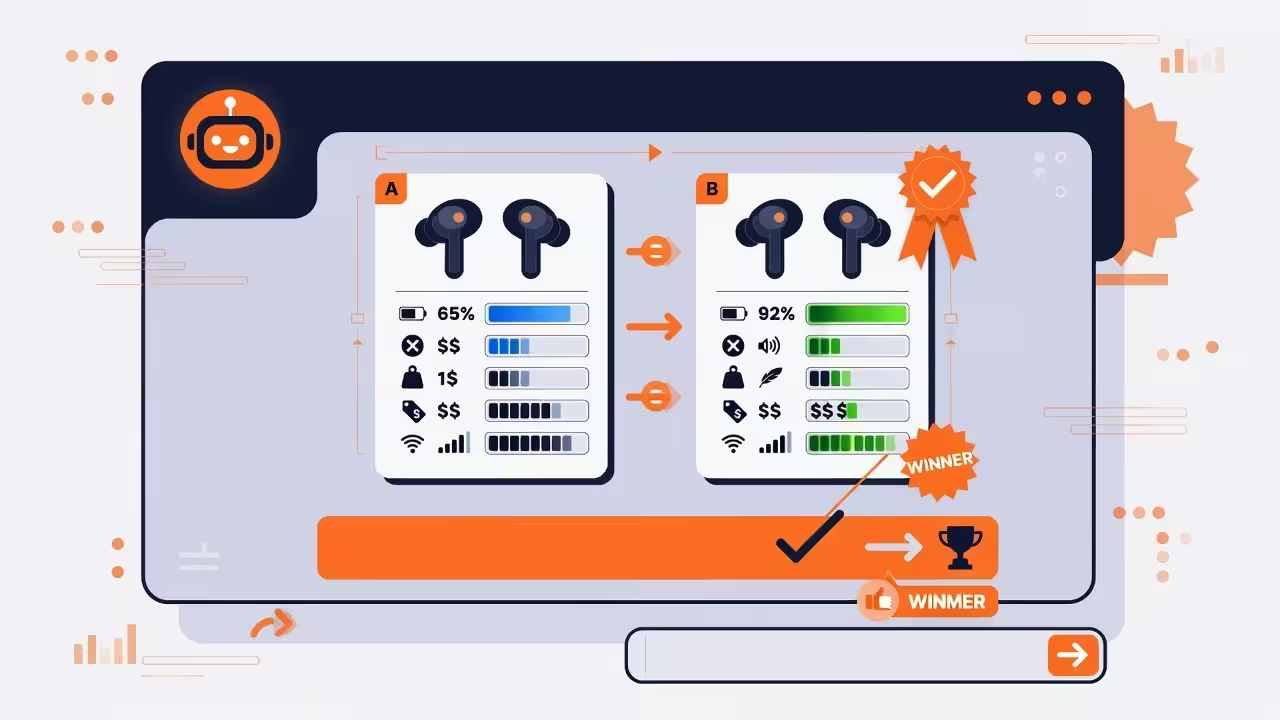
When someone asks an answer engine for the best replacement part under $200, the system has to resolve compatibility, price, availability, sentiment, and returns. It does not care who bought the Super Bowl ad.
Article Summary
- Shopping research inside answer engines compares structured attributes, availability, and review evidence, not only brand spend or photography.
- Complete, accurate, machine-readable product information levels the field for smaller catalogs.
- Run an attribute completeness audit: dimensions, materials, compatibility, box contents, warranty, returns, lead time.
- Product and Offer schema fields most stores leave empty are free ranking and citation fuel.
- Comparison and alternative-to pages are high-intent formats engines reach for.
One query end to end
PRO TIP Take "best replacement X for Y under $200." The engine needs: does it fit, what does it cost, can I get it, what do owners say, can I return it. Incomplete product pages force the model to skip you or guess wrong.
PRO TIP Paste your product page into an answer engine and ask it to compare against a named competitor. Whatever it gets wrong is a missing field on your page.
Attribute completeness audit
- Dimensions and weight
- Materials / specs that matter for the category
- Compatibility list (models, years, systems)
- What is in the box
- Warranty terms
- Return window
- Lead time / stock status
- Use cases and limitations (honest)
| Page element | Thin catalog | Answer-ready catalog |
|---|---|---|
| Page elementSpecs table | Thin catalogMissing or image-only | Answer-ready catalogText + structured |
| Page elementOffer schema | Thin catalogEmpty or wrong | Answer-ready catalogPrice, availability, currency |
| Page elementComparison pages | Thin catalogNone | Answer-ready catalogModel vs model, alternative-to |
| Page elementReviews | Thin catalogSparse or buried | Answer-ready catalogVisible, recent, specific |
| Page elementBuying guide | Thin catalogBlog fluff | Answer-ready catalogDecision criteria before the SKU |
Schema and comparison content
Product and Offer markup should match the visible page. Comparison and "alternative to" pages are the formats engines grab when asked to choose. Pair with AI visibility checklist, SEO/GEO, and fast product pages.
30-day catalog readiness plan
- Week 1: score top 20 SKUs on attribute completeness
- Week 2: fill missing fields and schema on those 20
- Week 3: publish 3 comparison or alternative-to pages
- Week 4: review corpus pass + buying guide for the category
Putting it together
Answer engines do not "like" your brand. They assemble attributes, comparisons, and proof. Incomplete specs lose to the competitor who published the sheet.
Finish the attributes. Build honest comparison pages. Make the schema match reality. That is how products get named when someone asks what to buy, not when you hope the model has good taste.
Talk with Xeal about product recommendation readiness
Bring a top SKU or category. We will show what is missing for AI shopping and classic search to recommend you.
FAQ
Does this only apply to big catalogs?
No. Small catalogs can complete attributes faster. Completeness is the advantage.
Do I need a feed?
Feeds help some channels. On-page completeness and schema still matter for answer engines reading the web.
What about marketplace listings?
Optimize both. Own-site depth is still your controlled asset.
How do I track AI-driven sales?
Use unique landing paths, surveys, and branded search lift. Perfect attribution is rare; directional is enough to invest.
Does my platform support this?
Most modern platforms can expose fields and schema if you fill them. The work is data quality, not a mythical plugin.
Is photography useless now?
No. Humans still buy. Machines need text and structure alongside images.
Sources
What operators say after working with Xeal
Quotes from people who hired Tony and Xeal for websites, SEO, publicity, and strategy.
Tony's creativity and vision are remarkable, and I've seen him produce impressive work time and time again.
Having worked with Tony since the mid-90s, I can attest that he is both a brilliant business partner and a transformative mentor. His expertise spans high-level web development and strategic marketing to high-impact publicity. We built a 400,000-follower movement with #IllegallyHealed. Tony brings innovation, technical skill, and relentless execution to every project.
Want help putting this into production?
If this article named a problem you already feel, tell me what is stuck. We will turn the playbook into systems your team can run.