
You're Not a Local Business: Why Local SEO Advice Backfires on National Service Companies

I have watched a company that ships work from all 50 states get told to "optimize the Google Business Profile" as if every buyer lives next door. National demand needs a national plan, not a single-store template.
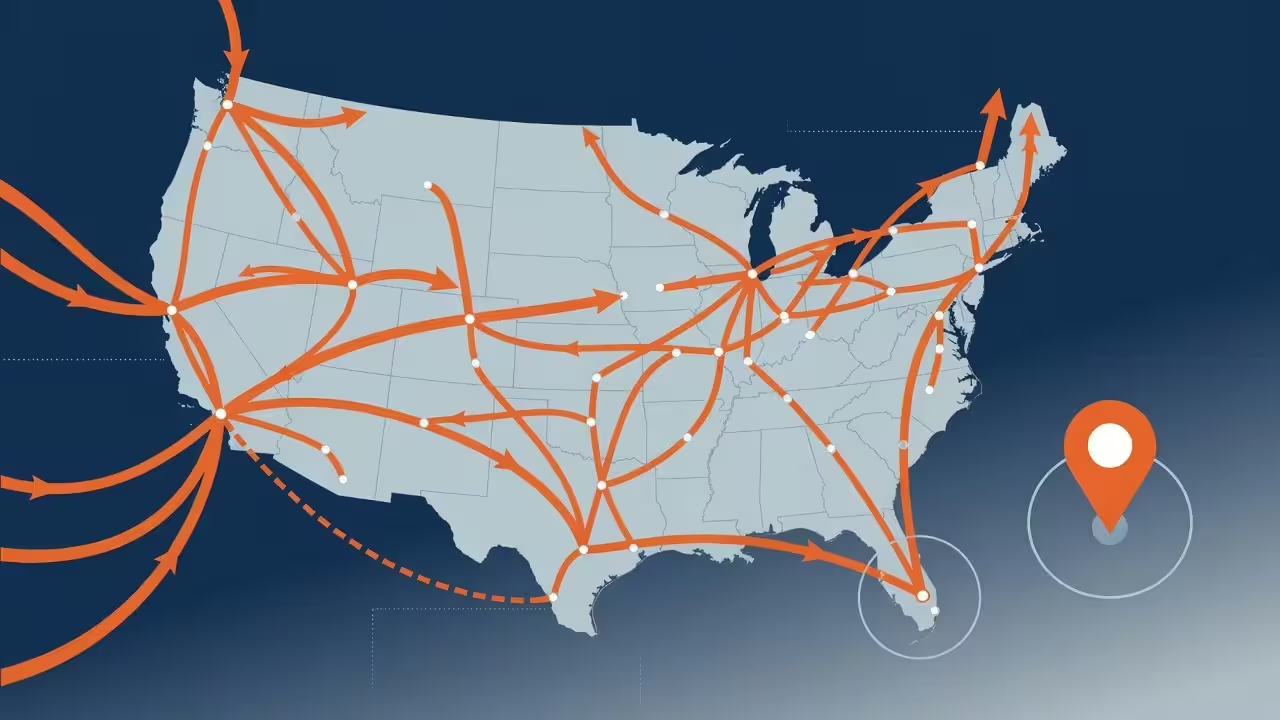
Article Summary
- Market geography determines method. Local SEO tactics that help a single-location plumber can waste money or harm a nationwide ship-in brand.
- Start with demand math: brand-only searches, category searches, and the combination. Those three numbers decide naming and content.
- Four geographies need four playbooks: single location, multi-location, service-area, and nationwide remote-service.
- City pages and aggressive GBP optimization are not default advice for companies with no storefront and national demand.
- Category terms in a business name can be legitimate when you actually operate under that name. Fake keyword names invite risk.
Demand math first
Before tactics, count three monthly demand shapes (Search Console, ads data, or honest keyword research):
- Brand-only - people who already know your name
- Category - people who know the problem, not you
- Brand + category - hybrid queries
PRO TIP Worked example (anonymized pattern): brand-only ~200/mo, category ~700/mo, combined reach ~900/mo. If category demand dwarfs brand demand, your content and naming strategy must respect category language. If brand already owns the market, do not torch equity for a theory.
The four business geographies
| Geography | What "local" means | Primary playbook |
|---|---|---|
| GeographySingle location | What "local" meansOne storefront / city | Primary playbookGBP, reviews, citations, local pages |
| GeographyMulti-location | What "local" meansMany stores | Primary playbookPer-location entities, consistent NAP, location pages that are real |
| GeographyService area | What "local" meansYou travel to customers in a region | Primary playbookService-area logic, careful GBP, city content only where you truly serve |
| GeographyNationwide remote / ship-in | What "local" meansCustomer sends work or you serve remotely | Primary playbookCategory authority, logistics, manufacturer/entity pages, not fake city spam |
Tactic by geography
| Tactic | Single location | Nationwide remote |
|---|---|---|
| TacticGoogle Business Profile | Single locationCore | Nationwide remoteOften secondary or carefully scoped |
| TacticCity pages | Single locationUseful when real | Nationwide remoteUsually waste or spam risk |
| TacticLocal citations | Single locationHigh value | Nationwide remoteTrade and industry sources over city directories |
| TacticReviews platform | Single locationGBP-heavy | Nationwide remoteGBP + industry + marketplace proof |
| TacticSchema | Single locationLocalBusiness variants | Nationwide remoteOrganization + service + sameAs clarity |
| TacticContent | Single locationLocal intent | Nationwide remoteCategory, how-to, logistics, comparison |
PRO TIP If your vendor's product is local SEO, their diagnosis will be local SEO. Ask them to state your geography map first. If they cannot, you are buying their product, not your strategy.
The naming decision, done properly
Category terms in a name can be legitimate when you actually operate under that name: DBA, logo, signage, invoices, tenure. They become risk when you invent a keyword name for search engines while the world knows you as something else.
A 30-year brand does not need a reckless rename. It may need a clear category line under the brand, strong title tags, and pages that use the words buyers type, without discarding equity. See also citations as entity resolution and mail-in funnel ops for nationwide ship-in realities.
What nationwide operators should do instead
- Category and manufacturer landing pages that are real
- Comparison and pricing-logic pages (honest ranges beat thin city clones)
- Entity clarity in Organization schema and sameAs
- Third-party corroboration: trade directories, dealer lists, reviews
- Ship-in / logistics content that reduces buyer friction
- Fast marketing site with apps off the marketing domain
Self-test: six questions
- Do customers walk into a storefront for this service?
- Do you travel to their address in a defined radius?
- Do you ship work in from many states?
- Is most demand brand-name or category-name?
- Would a city page describe a real team in that city?
- Would a local directory listing match how you actually operate?
Putting it together
Local SEO is powerful when you are local. It is expensive confusion when your demand is nationwide ship-in, remote, or model-driven.
Map geography first. Then pick tactics. Fake city pages and forced map-pack plays can train the wrong systems and hide the real buyer. I have watched national operators waste years that way.
Talk with Xeal about national vs local strategy
Tell me where customers actually are and how they buy. We will map geography before anyone builds another city page.
FAQ
Should I add a keyword to my business name?
Only if you truly operate under that name. Otherwise use brand equity plus clear category pages and titles.
Do I need a GBP if I have no storefront?
Maybe for some visibility and reviews, but it is not the whole strategy. Misconfigured GBP advice can waste months.
Are city pages ever right for national brands?
Only when there is a real local presence or a real local team. Fake city pages are a liability.
What about a physical shop that also ships nationally?
Run a hybrid: local playbook for the shop, national playbook for ship-in lines. Do not collapse both into one tactic set.
Will renaming hurt rankings?
Reckless renames can. Controlled brand + category clarity usually beats theatrical keyword names.
Who is this for?
Mail-in repair, national specialty services, ecommerce-plus-service hybrids, and any brand whose demand is not "near me" alone.
Sources
What operators say after working with Xeal
Quotes from people who hired Tony and Xeal for websites, SEO, publicity, and strategy.
Tony is truly a visionary. He's always coming up with new ideas for his company and his clients. As an entrepreneur, Tony is excellent at business consultation and speaking on the radio.
Tony has loads of experience when it comes to internet marketing. He has tested what does and doesn't work and is always up to date on the latest techniques that are working online. A true veteran in the industry.
Want help putting this into production?
If this article named a problem you already feel, tell me what is stuck. We will turn the playbook into systems your team can run.