
The Old Playbook Is Broken
You were told content compounds. Search engine optimization is a long game. Keep publishing and the traffic will come. That line still gets sold in retainer rooms. It is the wrong bet now.
Article Summary
- For every 1,000 US Google searches in early 2026, 232 clicks reached the open web. Search grew. Your slice did not.
- The buyer's first impression is now a box, a chat paragraph, or a review thread. Your .com is often the last stop, not the first.
- Search engine optimization still matters for the clicks that remain. Answer engine optimization and generative engine optimization are how you get named inside the answer.
- Publish proof a model can lift. Fix the entity. Ship an llms.txt map for the models. Make the visit you still get worth it.
- Stop arguing last-click sessions with the CFO. Count being named, being cited, and booked work.
232 clicks out of 1,000
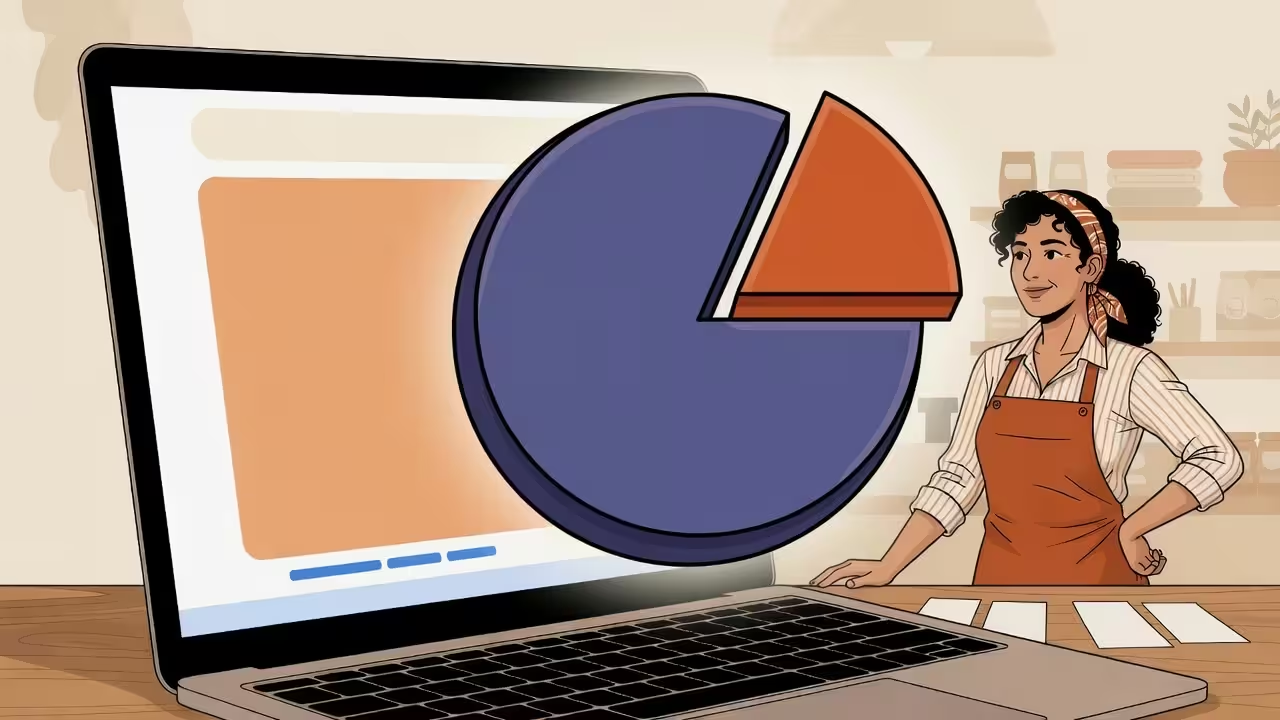
SparkToro and Similarweb measured US Google from January through April 2026. They published on 9 June 2026. 68.01% of searches were zero-click. For every 1,000 US searches, 232 clicks went to the open web.
The 2024 SparkToro and Datos study is history, not the current count. That paper put 360 open-web clicks per 1,000 US searches, and 374 in the EU. Fishkin has said 2024 and 2026 are apples and oranges. Do not mix them. Different panels. Different years. The direction is the only thing you should carry over: fewer clicks leave Google.
| What people quote | What it actually is | Use it for |
|---|---|---|
| What people quote232 open-web clicks per 1,000 US searches | What it actually isSparkToro + Similarweb, Jan-Apr 2026, published 9 June 2026 | Use it forThe current US count |
| What people quote68.01% zero-click | What it actually isSame 2026 study | Use it forHow often the session never leaves Google |
| What people quote360 US / 374 EU open-web clicks per 1,000 | What it actually isSparkToro + Datos, 2024 | Use it forHistory only. Do not treat it as 2026. |
| What people quoteOrganic traffic -2.5% year over year | What it actually isGraphite on Similarweb, 40,000-plus US sites, covered 20 January 2026 | Use it forA smaller slice of a bigger pie, not a 10% market crash |
AI Overviews are in more of the queries you care about. BrightEdge, 12 February 2026: about 31% of tracked queries a year earlier, about 48% now. Ahrefs, 4 February 2026: AI Overviews correlate with 58% lower click-through on the top result. Semrush, 2 July 2026: commercial-intent results with an AI Overview rose 71% from November 2025 to April 2026. The money queries are in the box.
Graphite, via Search Engine Land, 20 January 2026: organic traffic down 2.5% year over year across 40,000-plus US sites. That is not a 10% market crash. It is a smaller slice of a bigger pie. Rank if you want. Count sessions if you want. Be named where the answer happens. Convert the visit you still get.
Search is not dying. The click is optional.
SparkToro and Datos, 3 March 2026, on Q4 2025: all AI tools were 3.2% of US desktop search-like activity. Google was 73.7%. Traditional search engines were about 80%. A ChatGPT answer is still a homepage. I heard a founder at MicroConf describe a Formspree customer who found them in Claude, signed up, and never needed the marketing site first. That path is research, not a Xeal client. The pattern is real: the recommendation can close before your homepage loads.
PRO TIP When a dashboard screams "organic is down," open revenue, branded search, booked work, and reply volume before you fire the channel. Clicks and booked work can move in different directions.
Your first impression is not your .com
The buyer asks a question. Google writes a box. ChatGPT writes a paragraph. A review thread writes the reputation. Your homepage, if they ever see it, is late.
The public record is what those systems lift. Reviews. Forums. Snippets. Third-party mentions. If your proof lives in Slack, in a deck, or in your head, the model cannot cite it. Someone else's one-star note can.
A published 2026 generative engine optimization case showed one negative review theme appearing 67 times in branded AI outputs. The company put the real retention number on a public page, 79.2%. After two citations the models dropped the old line. That post lasted a few months. The citations were gone by February. They had to publish again.
Industry tracking on 24 July 2026 found about 75% of pages that get cited were updated in the last year. Refresh the page you already have. Do not only ship new URLs. A citation win you never touch will rot.

Ask ChatGPT for the best Hardie siding contractor in Tulsa and a current name comes up first. This week that name is Tulsa Renew. That is a citation win. Keep the public record current. Screenshot this week's answer. Check again next month.
PRO TIP Ask ChatGPT, Gemini, Perplexity, Copilot, and Claude the branded questions your buyers already ask. Screenshot what they say about you. That dump is your public-record punch list, not a vanity clip for the sales deck.
Datos and SparkToro, 27 July 2026, on Q2: US desktop organic click share was 40.0% in June, down from 44.9% in March. Attribution as we built it is over. The last click still gets the trophy. The four steps before the branded Google still did the work. Marketing now is understanding, trust, recall, and preference wherever the buyer already is.
When you need the identity side of this, open citations as entity resolution. When the engine is repeating a story you do not like, pair it with reviews as training data and earned media that gets cited.
What still works
Search engine optimization, or SEO, still matters. If you cannot be found on the 232 clicks that remain, you lose those too. Rank for the clicks. Get named in the answer.
llms.txt is a map at the root of your site for large language models. The name is the job: large language models, plural. ChatGPT, Claude, Gemini, Perplexity, Copilot, Grok, Llama, Mistral, on-device models, vertical assistants, and dozens more that are already in the wild or about to be. Ship it so those systems can find who you are and which pages to cite. Google Search is a different job. Google Search Central said on 15 June 2026 that Search itself ignores the file, including its generative features. Expected. That file was built for the models that write the answer, not for the ten blue links fewer people click. We future-proof by shipping llms.txt. We keep ranking with extractable HTML, a consistent entity, and public proof. See ours at xeal.net/llms.txt.
| Layer | What the buyer gets | What you still control |
|---|---|---|
| LayerSEO (search engine optimization) | What the buyer getsA page of results to scan | What you still controlCrawlable pages, relevance, the 232 clicks that still leave Google |
| LayerAEO (answer engine optimization) | What the buyer getsOne spoken or featured sentence | What you still controlExtractable facts: name, hours, category, a line an assistant can read |
| LayerGEO (generative engine optimization) | What the buyer getsA written recommendation with a name on it | What you still controlPublic proof a model can cite: dated numbers, consistent entity, third-party mentions |
GEO and AEO are the next layer. Get named and cited in the answer, and in the blue link. That means extractable pages, a consistent entity, and a public record that agrees with what you say about yourself. At Xeal we work the parts you control: extractability, evidence, entity. When you want the full scorecard, use the 40-point visibility checklist.
Speed is still the site you do get the visit for. Flat HTML. Chat the file on a hard drive, push to GitHub, live on Cloudflare. A slow WordPress stack that ranks and then dumps the visitor is the old playbook in a new skin. Fast pages are how we deliver the visit. Xeal is a Strategic Marketing and AI Engineering consultancy, NAICS 541613. If you need the stack argument, read the flat-file comeback.
When an agent or a logged-in buyer does arrive, the page has to do a job. Quote. Book. Hand off. That is named actions on the site you already have, the same capability I walked through in What's WebMCP.
The cheap work (research, rewrites, file edits) can run on a local model. Hermes or Ollama on the machine. Cloud tokens stay on the hard problems. That is how we collapse time on the work.
If the only job is a receptionist that books missed calls, that is xealai.com. The rest of this work is the consultancy.
Two blog posts a month will not save you here. Coverage and proof will. That is why cadence is a 2018 answer.
What to do Monday
The old playbook said keep publishing. The new one says get recommended, get cited, and convert the click that remains. Start here.
- Publish less that exists only to rank. Publish the proof a model can lift: named numbers, dated, on a page that stands alone.
- Fix the entity. One sentence, used on the site, in schema, on the two or three third-party pages that already mention you, and in
llms.txtso the models have a map. - Make the visit you still get worth it. Fast HTML. A quote or a book action that an agent can complete.
- Refresh the public record on a schedule. A citation win you never touch will rot. The 75% figure is the reminder.
- Stop arguing with the CFO about last-click sessions. Show branded search, replies, booked work.
| Old playbook | What to do instead |
|---|---|
| Old playbookKeep publishing until traffic compounds | What to do insteadPublish extractable proof. Kill thin URLs that exist only to hit a calendar. |
| Old playbookRank, then screenshot page one | What to do insteadGet named in the answer. Then convert the click that still arrives. |
| Old playbookLast-click sessions as the scoreboard | What to do insteadBranded search, replies, booked work, and whether the model says your name. |
| Old playbookShip a new post. Never touch last year's winner | What to do insteadRefresh the pages that already get cited. Most cited pages were updated in the last year. |
| Old playbookSkip llms.txt because Google Search ignores it | What to do insteadShip llms.txt as a map for large language models. Dozens of them. Rank on Google with extractable HTML. |
Putting it together
You can still rank. You should. You cannot treat ranking as the whole match.
Be findable on the 232 clicks that remain. Be extractable when Siri reads one line. Be citable when any of the dozens of large language models writes a name. Ship the llms.txt map so they can find you. Then make the visit you still get finish a quote or a booking.
At Xeal we treat this as strategy and delivery: extractable pages, a current public record, an llms.txt map for the models, and a visit that can finish a quote. Get recommended. Get cited. Convert the click that remains.
Talk with Xeal about getting named and converting the click
Tell me what ChatGPT, Gemini, and Google already say about you. We will map the proof you can publish, the entity fights to fix, and the visit you still get.
FAQ
Is SEO dead in 2026?
No. Search engine optimization still decides who gets the 232 open-web clicks that remain out of every 1,000 US Google searches. Graphite's look at 40,000-plus US sites put organic traffic down 2.5% year over year, which is a smaller slice of a bigger pie, not a funeral. What died is the idea that ranking plus a publishing calendar is the whole game. You still need to be findable. You also need to be named in the answer and useful when the visit arrives.
What does 232 clicks out of 1,000 mean?
SparkToro and Similarweb measured US Google from January through April 2026 and published on 9 June 2026. For every 1,000 searches, 232 clicks reached the open web. 68.01% of searches were zero-click, meaning the session never left Google. The 2024 SparkToro and Datos numbers (360 US, 374 EU) are a different panel and a different year. Fishkin has said not to mix them. Use 232 as the current US count.
Should I create an llms.txt file?
Yes. llms.txt is a map for large language models. There are dozens, not three. ChatGPT, Claude, Gemini, Perplexity, Copilot, Grok, Llama, Mistral, phone assistants, on-device models, and more coming. Ship a clean file that states who you are and which pages to cite. Google Search ignores it, which is expected. That file was never the ranking trick. We future-proof for the models that already write the answer. We still rank on Google with extractable pages, a consistent entity, and public proof.
What is the difference between SEO, AEO, and GEO?
SEO, search engine optimization, is the search page: a ranking slot a buyer can scan. AEO, answer engine optimization, is the one-line answer Siri or a snippet reads out loud. GEO, generative engine optimization, is when ChatGPT, Gemini, Perplexity, Copilot, or Claude writes a recommendation and puts a name on it. Most retainers still only measure the first game. Ranking without being extractable is how you win SEO and lose the phone. Ranking without being citable is how you win SEO and lose ChatGPT.
If AI tools are only 3.2% of search, why bother?
Because a ChatGPT or Claude answer is already a homepage. SparkToro and Datos put all AI tools at 3.2% of US desktop search-like activity in Q4 2025, with Google at 73.7% and traditional search around 80%. Share of queries is not share of decisions. A buyer who gets named in the answer may never need your marketing site first. You still fight for Google. You also fight to be the name inside the smaller, higher-intent channel.
What should I publish if volume no longer compounds?
Publish proof a model can lift: named numbers, dated, on a page that stands alone. Refresh the pages that already get cited. Industry tracking in July 2026 found about 75% of cited pages had been updated in the last year. Two blog posts a month was a staffing compromise, not a law of ranking physics. Coverage and truth beat calendar guilt. Kill thin URLs that exist only to hit a quota.
How do I know if the model is lying about my business?
Ask the engines the branded questions your buyers already ask, then screenshot the answers. If a one-star theme is the only public record, that is what they will lift. Put the real numbers on a page they can cite, then keep that page fresh. A 2026 case showed one negative theme appearing 67 times until two citations of a real retention figure, 79.2%, knocked it out. The citations later went stale. Maintenance is the product.
Sources
- SparkToro + Similarweb: 2026 zero-click study (68.01%, 232 open-web clicks per 1,000 US searches)
- SparkToro + Datos, 2024: 360 US / 374 EU open-web clicks per 1,000 (historical only)
- SparkToro + Datos, 3 March 2026: all AI tools 3.2% of US desktop search-like activity, Google 73.7%
- BrightEdge, 12 February 2026: AI Overviews about 31% to about 48% of tracked queries
- Ahrefs, 4 February 2026: AI Overviews correlate with 58% lower top-result CTR
- Graphite / Search Engine Land, 20 January 2026: organic -2.5% YoY across 40,000-plus US sites
- Graphite: organic search has not dramatically declined
- Semrush, 2 July 2026: commercial-intent SERPs with AI Overviews +71% (Nov 2025 to Apr 2026)
- Datos / SparkToro State of Search Q2 2026, 27 July 2026: US desktop organic click share 40.0% in June, from 44.9% in March
- Google Search Central, 15 June 2026: Search ignores llms.txt. The file is for large language models, not the blue-link layer.
- Xeal: llms.txt
- Xeal: How to get AI search engines to recommend your business
- Xeal: Citations and entity resolution
- Xeal: What's WebMCP
- Xeal: SEO, AEO, and GEO
What operators say after working with Xeal
Quotes from people who hired Tony and Xeal for websites, SEO, publicity, and strategy.
Tony is truly a visionary. He's always coming up with new ideas for his company and his clients. As an entrepreneur, Tony is excellent at business consultation and speaking on the radio.
Tony has loads of experience when it comes to internet marketing. He has tested what does and doesn't work and is always up to date on the latest techniques that are working online. A true veteran in the industry.
Want help putting this into production?
If this article named a problem you already feel, tell me what is stuck. We will turn the playbook into systems your team can run.